James A. Cook

James A. Cook is a historian of modern China and associate director of the Asian Studies Center at the University of Pittsburgh.

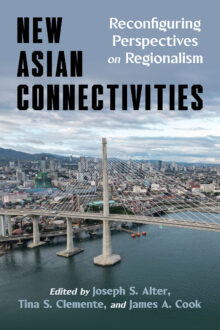
New Asian Connectivities

Reconfiguring Perspectives on Regionalism

This volume brings together scholarship in the humanities, social sciences, business, and law to reimagine the nuances of regional interconnectivity in Asia and to challenge notions of boundaries and boundedness in reconceptualizing the field of Asian studies. Focusing on connections that animate Asian regionalism and the academic study of Asia, these chapters operate in three overlapping interdisciplinary areas: the construction of cultural positionality in literature, musical performance, and narratives of self-discovery; the interdependence of governance, policy, and legislation in national, bilateral, and multilateral politics; and the enmeshment of regionalized political economies—through ties of cooperation and competition, productivity and extraction, exploitation and investment—amid increasingly decentralized global power. These contributions foreground analyses of cultural production, economic flows, and social mobility that cut across South and Southeast Asia and extend toward East and West Asia to form new networks of regional interconnection. Pushing against the rigid boundaries of nationalized identities, state institutions, internationalized development schemes, and government-sanctioned trade policies, these essays reexamine the diverse dimensions of intra-Asian regionalism and its robustness as an approach to scholarly inquiry.

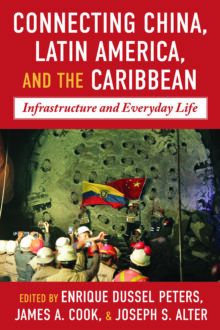
Connecting China, Latin America, and the Caribbean

Infrastructure and Everyday Life

A long history of migration, trade, and shared interests links China to Latin America and the Caribbean. Over the past twenty years, China has increased direct investment and restructured trade relations in the region. In addition, Chinese public sector enterprises, private companies, and various branches of the central government have planned, developed, and built a large number of infrastructure projects in Latin America and the Caribbean, such as dams, roads, railways, energy grids, security systems, telecommunication networks, hospitals, and schools. These projects have had a profound impact on local environments and economies and help shape the lived experiences of individuals. Each chapter in this volume examines how the impact of these infrastructure projects varies in different countries, focusing on how they produce new forms of global connectivity between various sectors of the economy and the resulting economic and cultural links that permeate everyday life.