Ian Hesketh is associate professor of history in the School of Historical and Philosophical Inquiry at the University of Queensland.
The seventeenth volume of The Correspondence of John Tyndall includes 456 letters, documenting a pivotal period in his life. It opens with Tyndall’s resignation from his long-held post as scientific adviser to the Board of Trade and Trinity House, a decision that provoked a very public dispute with a government minister. During these years, Tyndall became increasingly outspoken on political affairs, denouncing the domestic and foreign policies of William Gladstone’s Liberal governments and aligning himself more firmly with conservatism. His private life also entered a new phase with the purchase of a large plot of land at Hindhead, where he and his wife, Louisa, would eventually settle after enduring the considerable strain of building a new home. Though he remained superintendent of the Royal Institution of Great Britain—continuing to deliver lecture courses and the occasional Friday Evening Discourse—his correspondence reveals that scientific research, while still important, now occupied a smaller share of his time and attention.
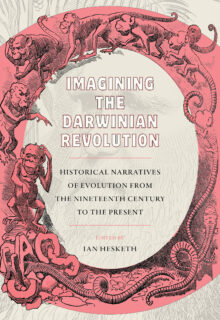
Since Charles Darwin’s death in 1882, people across the world have used forms of commemoration and memorialization to celebrate, and at times critique, various aspects of Darwin’s scientific, social, and cultural impact. Commemorative events, activities, and publications marking major anniversaries of Darwin’s birth and death, of the publication of On the Origin of Species (1859) and other works, and of the Beagle voyage, have been occasions for the casting and recasting of narratives of the history of evolutionary science, spurs to new historical research, and episodes in the public legitimation of contemporary scientific developments. They have engendered much discussion and debate about relations between evolution and religious belief as well as political questions related to issues of nation-building and social development. This volume examines these commemorative activities in global perspective, exploring the complexity of meanings of Darwin and his science to different social, cultural, scientific, and national groups, from the moment of Darwin’s death up to the recent sesquicentennial of The Descent of Man (1871) in 2021.

This volume considers the relationship between the development of evolution and its historical representations by focusing on the so-called Darwinian Revolution. The very idea of the Darwinian Revolution is a historical construct devised to help explain the changing scientific and cultural landscape that was ushered in by Charles Darwin’s singular contribution to natural science. And yet, since at least the 1980s, science historians have moved away from traditional “great man” narratives to focus on the collective role that previously neglected figures have played in formative debates of evolutionary theory. Darwin, they argue, was not the driving force behind the popularization of evolution in the nineteenth century. This volume moves the conversation forward by bringing Darwin back into the frame, recognizing that while he was not the only important evolutionist, his name and image came to signify evolution itself, both in the popular imagination as well as in the work and writings of other evolutionists. Together, contributors explore how the history of evolution has been interpreted, deployed, and exploited to fashion the science behind our changing understandings of evolution from the nineteenth century to the present.
New attitudes towards history in nineteenth-century Britain saw a rejection of romantic, literary techniques in favour of a professionalized, scientific methodology. The development of history as a scientific discipline was undertaken by several key historians of the Victorian period, influenced by German scientific history and British natural philosophy. This study examines parallels between the professionalization of both history and science at the time, which have previously been overlooked. Hesketh challenges accepted notions of a single scientific approach to history. Instead, he draws on a variety of sources—monographs, lectures, correspondence—from eminent Victorian historians to uncover numerous competing discourses.
The 329 letters in this volume represent a period of immense transition in John Tyndall’s life. A noticeable spike in his extant correspondence during the early 1850s is linked to his expanding international network, growing reputation as a leading scientific figure in Britain and abroad, and his employment at the Royal Institution. By December 1854, Tyndall had firmly established himself as a significant man of science, complete with an influential position at the center of the British scientific establishment.
Tyndall’s letters throughout the period covered by this volume provide great insight into how he navigated a complicated course that led him into the upper echelons of the Victorian scientific world. And yet, while Tyndall was no longer as anxious about his scientific future as he was in previous volumes of his correspondence, these letters show a man struggling to come to terms with his newfound status, a struggle that was often reflected in his obsession with maintaining an “inflexible integrity” that guided his actions and deeds.